
The birth of Napoleon’s son
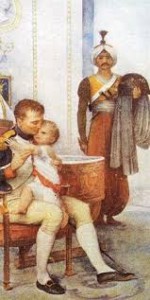 Napoléon François Charles Joseph Bonaparte was born at 9.20 in the morning in the Tuileries. There was a great commotion in the palace as the court and functionaries of state waited with impatience, none more so than Napoleon himself. The Emperor was in a state of great agitation. He was overheard saying to Marie Louise’s obstetrician, ‘Pretend that you are not delivering the Empress but the bourgeois from the Rue de St Denis.’ It wasn’t an easy delivery and when asked who he would want to save in the event of an emergency, the mother or the child, Napoleon replied, ‘Save the mother,’ despite everything he had to go through for an heir.
It had been announced that the birth of a daughter would be saluted with 21 guns and that of a son by 101. When the people heard the 22nd boom of the cannon, there were great celebrations in Paris. The infant was proclaimed the King of Rome, a title of the Holy Roman Empire, and was nicknamed the Eaglet by the Bonapartist propagandists. ‘My son is big and healthy,’ Napoleon wrote to Josephine. ‘I hope he will grow up well. I trust that he will fulfill his destiny.’
Napoleon was a very loving father, who was inordinately proud of the boy’s bloodline, pointing out that the boy was related to the Romanovs through his mother’s brother-in-law, to the Habsburgs through his mother, to the Hanoverians through his uncle’s wife and to the Bourbons through his mother’s great-aunt. The fact that all four families currently longed for Napoleon’s overthrow didn’t seem to lessen his joy.
 Napoleon begins his assault on Acre, surrounding the town with fortifications and trenches. Defending the port were 4000 Afghans, Albanians and Moors, as well as Commodore Sir Sidney Smith with 200 marines. Napoleon launched no fewer than nine major and three minor attacks on Acre over the next nine weeks.
 Although only a short while previously Michel Ney had told Louis XVIII, ‘I will bring you Bonaparte in an iron cage,’ he deflected to Napoleon’s side with almost all his troops except for a few royalist officers. Ney’s loyalties were torn and it was by no means an easy decision. When Napoleon sent a message to Ney that read, ‘Should you decide to change sides, I will receive you like I did at the morrow of the Battle of the Moskova,’ the marshal couldn’t resist following his heart instead of his head.
 Napoleon and his brother Joseph subjected Josephine to a tough interrogation that left her tearful, distressed and resentful but as deceitful as ever. Alongside her current lover Hippolyte Charles and her former lover Barras, Josephine was an investor in a firm that had long been accused of invoice manipulation, providing substandard equipment, rotting provisions and even direct horse thieving from peasants. The involvement of his wife in such shady dealings affected Napoleon’s strongest appeal to the populace – his integrity.
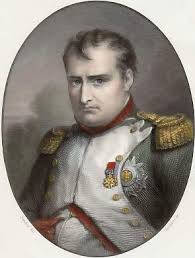 At the Congress of Vienna, following Napoleon’s return from Elba, the Great Powers of Europe (Austria, Great Britain, Prussia and Russia) and their various smaller allies declared Napoleon an outlaw. It was the first time in history that war was declared against a particular person rather than a nation.
 Napoleon was told that his older brother Joseph, who was entrusted by Napoleon with the defense of Paris, was trying to seduce Napoleon’s wife Marie Louise, who acted as a regent in his absence. ‘King Joseph told some wearisome things to me,’ Marie Louise wrote to her husband. To which Napoleon replied, ‘Do not be too familiar with the King. Keep him at a distance. Do not allow him to enter your private apartments. Mistrust the King. All this depresses me rather. I need to be comforted by the members of my family but as a rule I get nothing but vexation from that quarter. On your part, however, it would be unexpected and unbearable.’ To Joseph he wrote: ‘If you want to have my throne, you can have it. But I ask you one favour: to leave me the heart and the love of the Empress.’
 After the French army took Jaffa during the Egyptian campaign, many soldiers became infected with the plague. Napoleon visited the hospital and, according to one of the officers, picked up and carried a plague victim who was lying across the doorway. ‘This action scared us a lot because the sick man’s clothes were covered in foam,’ wrote the officer.
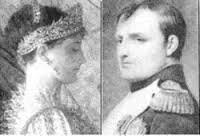 Marriage of Napoleon and Josephine
 Napoleon encounters soldiers of the 5th on his return from Elba
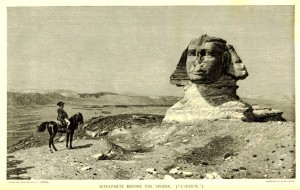 The Directory gave Napoleon cart-blanche to organise full scale invasion of Egypt with the strategic aim of destroying British influence in the Eastern Mediterranean and replacing it with the French. It was in the Directory’s best interests to send Napoleon as far away from Paris as possible. His popularity was growing, while theirs declined. Fearing a coup, the feeble Directory was anything but secure in its position. If Napoleon went to Egypt, he might conquer it for France, which would be good, and he might die in the process, which would be even better. And were he to be defeated, the public opinion might turn against him.